Author: Todd Scott

  • Biking to Detroit’s musical heritage

    Detroit has a tremendous history, which makes for some great biking destinations.

    Yesterday I rode to 635 Belmont Street just north of Detroit’s Arden Park-East Boston Historic District. This is where Diana Ross grew up until she was 14 and her family moved to the Brewster-Douglass Housing Projects, those abandoned towers just north of Ford Field.

    The Brewster-Douglass projects were also home to Lily Tomlin, Diana Ross, Mary Wilson, Florence Ballard, and Smokey Robinson. And, Bettye Lavette lived across the alley from Smokey.

    Bettye has an amazing story. She recorded a hit single when she was just 16, but little success followed. She spent 40 years trying to make it in the music business. Much of that time was spent in the Locker Room Lounge on Livernois not too far north from the University of Detroit-Mercy campus.

    While her fortunes have turned around with her two most recent albums, in this interview, she reflects on her less successful times.

    This evening I’m going to a place [in Detroit] called The Locker Room, which is what the “Old Soldiers” song is really about [to me]. I was in there at least two nights a week, whenever I could get a ride. The Spinners hung out in there and sat at the big shot end of the bar, and I sat at the dirty end as they called it. But I would send all of my tabs up to the big shot end [laughs]. I hung there for 10 or 15 years…so often people would come in and say things like “Didn’t you used to be Bettye Lavette?” or “Do you still sing” A lot of love happened there, a lot of drunk happened there, a lot of crying…but I know that I can always go there.

    Bettye’s video for “Old Soldiers” was filmed at the Locker Room.

    [Yes, the Locker Room Lounge is on the 2009 Beers and Gears ride. We’ll be at the dirty end.]
  • Those crazy old sports jocks

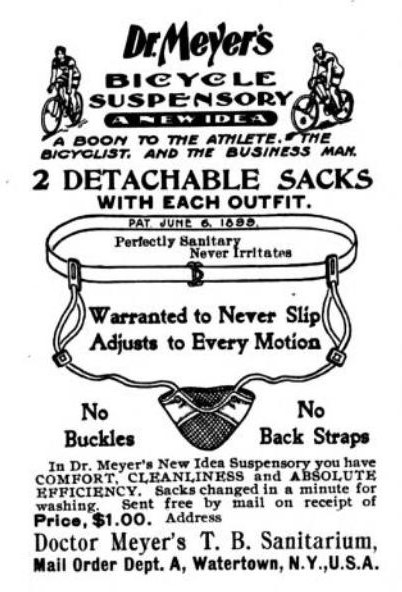
    Jocks strap for cyclists from 1901I spent a good deal of time reading old League of American Wheelmen (L.A.W.) Bulletins from the late 1890s and early 1900s. The L.A.W. was the main bicycling group during the time when bikes were king.

    Not unexpectedly, I came across some funny old time advertisements, not unlike what you used to see on the tables at Wendy’s restaurants.

    But I tend to doubt the ad on the right ever appeared at Wendy’s.

    I will give Doctor Meyer’s credit for a minimalist design and detachable sacks, though the latter just doesn’t sound right.

    However, I bet the Doctor is being optimistic about the “never irritates” claim. Please tell me the sacks weren’t made from scratchy wool.

    Fortunately this wasn’t the only option advertised. This jock from Sharp and Smith was also just a buck.

    For me, the main selling point is Major Taylor “and other cracks” wear this brand.

    Then again, today’s basic lycra bike shorts work just fine.

  • I was held up by gunmen while biking

    I was biking down Vinsetta Boulevard in Royal Oak last week and all of a sudden there was a major traffic jam.  This was real odd because normally there are few cars on that road.

    So I slowly weaved through the stopped cars, past a policeman, and continued  on Vinsetta.

    The only difference now was I was on a movie set. Oops.

    At Main Street, someone asked me to stay out of Wagner Park as they were filming the remake of horrifically bad movie Red Dawn.

    I went north on Main and there there were. Four gunmen. I rode past without a shot being fired. Russian? Chinese? American? Dunno.

    Just another day of biking in Hollywood.

  • Racing with Vitamin I

    800px-Ibuprofen_3D_ModelA recent New York Times article asked the question, “Does Ibuprofen Help or Hurt During Exercise?”

    The short answer is no, unless your suffering from “inflammation and pain from an acute injury.”

    The article discusses ibuprofen use at the Western States 100-mile run.

    Those runners who’d popped over-the-counter ibuprofen pills before and during the race displayed significantly more inflammation and other markers of high immune system response afterward than the runners who hadn’t taken anti-inflammatories. The ibuprofen users also showed signs of mild kidney impairment and, both before and after the race, of low-level endotoxemia, a condition in which bacteria leak from the colon into the bloodstream.

    These findings were “disturbing,” Nieman says, especially since “this wasn’t a minority of the racers.” Seven out of ten of the runners were using ibuprofen before and, in most cases, at regular intervals throughout the race, he says. “There was widespread use and very little understanding of the consequences.”

    Endotoxemia? Ah, no thanks.

    Years ago another runner shared a supposed racing secret: Taking a couple ibuprofens before running a marathon helps reduce inflammation during the race.

    I tried it before running Boston in 2002. Although I ran well, my muscles were no less sore than after other marathons.

    I took ibuprofen before a few more running races but eventually stopped. There was nothing to gain and research was showing that taking it could slow the body’s natural recovery process (also noted in the NYT article.)

    But there’s also another danger to popping ibuprofen. If you become dehydrated, you could suffer from renal failure where your kidneys  shut down. This is really stressed at the Leadville races since dehydration is more likely during endurance events at high altitudes.

    Near the end of this year’s Leadville run, I did take two acetaminophen (Tylenol) for my ankle injury/inflammation. Acetaminophen can also produce the renal failure when dehydrated so I made sure my system fully hydrated.

    After the race I relied more on ice to reduce inflammation. It seems to work far better than ibuprofen or acetaminophen — and it doesn’t help put bacteria in your bloodstream.

  • The Race Across the Sky

    It’s a little hard to believe how popular the Leadville bike race has become.

    I called Cullen Watkins back in 1996 to see if he’d want to do some 100-mile mountain bike race in Colorado. He said, “yeah” so we sent in our entries.

    We took the race for granted, just showed up, never bothered to pre-ride any of the course — how hard could it be? — and it kicked our butts. We kept coming back year after year and bringing more Michigan racers into the Leadville family.

    And now after a few Leadvilles with top Tour de France pros, including Lance Armstrong, there’s now a movie in the works.

    Who’d a thunk?