I think I’ve only crashed two or three times this year.
One was in Birmingham. There was slick ice on the roads and a thick layer of loose snow on top. I was running studded Nokian tires, but the snow kept them from hooking up on the ice. It wasn’t that bad of a crash since you can’t go too fast in these conditions and snow is fluffy. My riding partners even noted that I was laughing as I fell.
So that wasn’t my number one crash.
It was in the middle of summer and I was on a long ride. My purpose was to scout the planned Rouge Gateway trail extension along the Rouge River from Michigan Avenue to the Fort Street Bridge.
This segment of the Rouge River had been heavily modified through the years in order to accommodate large Great Lakes ore vessels on their way to Ford’s Rouge Plant.
Keeping the river in a more natural state was clearly not a priority. It had been dredged, straightened, and eventually placed in a concrete trough.
More scratches on glasses = less abrasions on face
On the bright side, that concrete is somewhat fun to ride. It gently slopes towards the river and you just need to avoid the occasional dead wood. It’s like the Dorais Velodrome with any turns.
My scouting ride was following some recent rains, so there were some wet spots where water was flowing over the concrete to the river. It was no biggie — or so I thought.
One time it wasn’t just water. It was a slimy, wet algae mix. I was riding about 15 MPH when my front wheel hit that slick concoction and slipped sideways down the concrete slope. My handlebar end was the primary contact point with the concrete and a quarter-inch of metal was quickly ground off. My knees, hands, and face eventually hit the hard surface as well and I quickly slid to a stop.
I took inventory, swore, flushed the blood off my face with my water bottle and got back on the bike. I really thought about continuing my ride, but all my cleanup meant I was nearly out of water. Oh, and everything hurt, too.
I rode 15 miles home, cleaned up my wounds, and bandaged my knees and face. My cut above my eye got a butterfly bandage and didn’t require stitches. I got a tetanus shot just in case.
Yes, it’s premature to blog about your year’s biggest crash with three months remaining, but I’m an optimist.
One resource that makes biking in Detroit so unique and spectacular is its historic churches.
Ste. Anne de Detroit
Did you know that the second oldest continuously open Catholic parish in North America is in Corktown? St. Anne was founded by Cadillac in 1701, the same year as the City of Detroit. The parish is now in their 8th church, which was opened in 1887.
Father Gabriel Richard is called the Second Founder of Detroit and is the church’s more famous pastor. He rallied Detroiters to rebuild the City after the Great Fire of 1805. In fact he gave the City its motto: Speramus Meliora; Resurget Cineribus (“We Hope For Better Things; It Shall Rise From the Ashes”.)
Richard was a founder of the University of Michigan, MIchigan’s delegate to Congress when it was just a territory, and lobbied for the completion of Michigan Avenue from Detroit to Chicago.
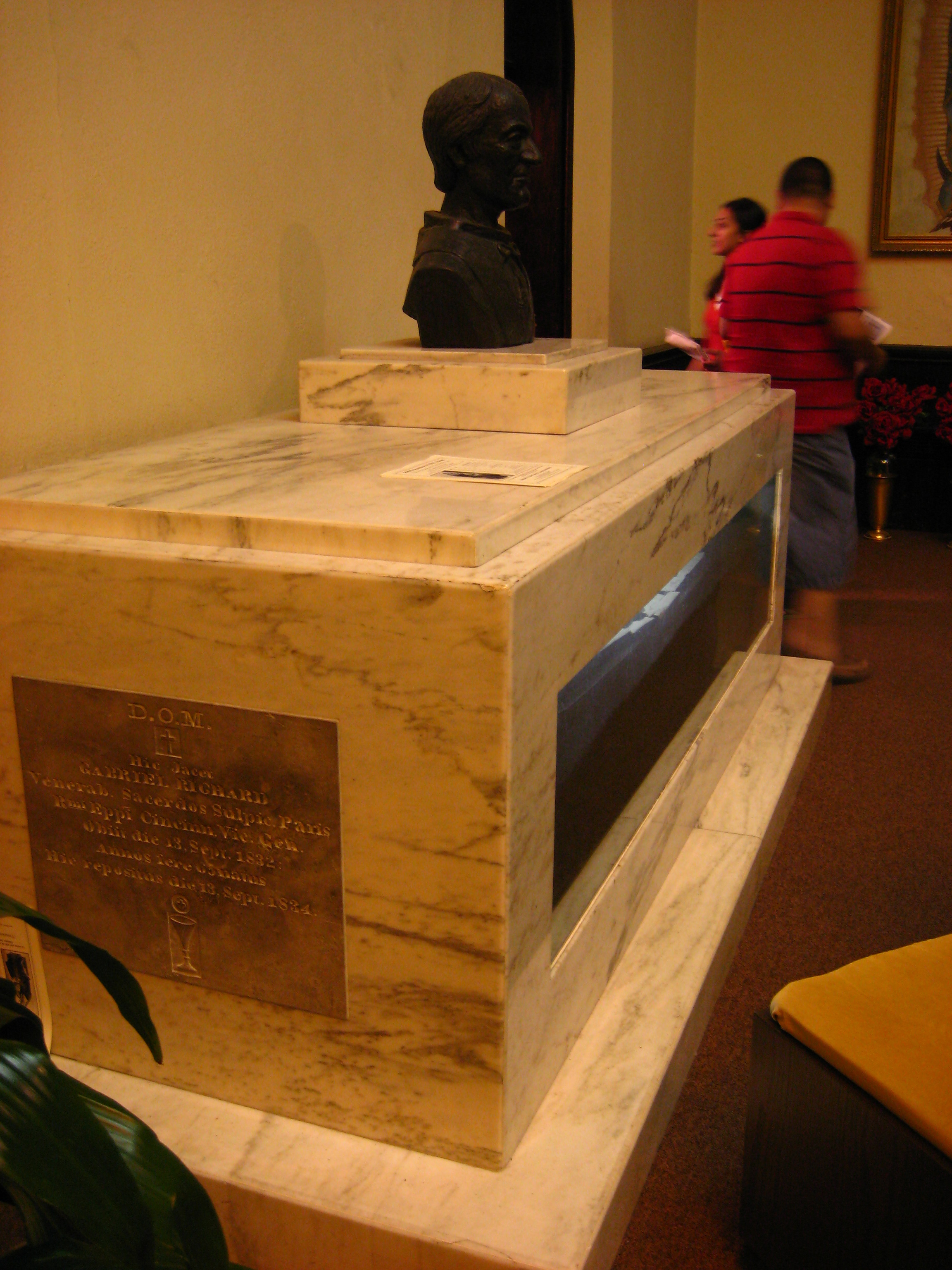
Richard’s remains are kept in a chapel at the church.
Gabriel Richard’s remains at Ste. Anne
Sweetest Heart of Mary
This is beautiful church just north of Eastern Market and situated midway between the St. Albertus and St. Josaphat churches. All three Catholic churches served the Polish communties on Detroit’s east side.
Below is an excert from Olivier Zunz’ book, “The Changing Face of Inequality:”
The building of Sweetest Heart of Mary and the controversy that surrounded it provides a perfect example of the Poles’ difficulties with the hierarchy and of their dedication to their churches. It also sheds light on internal dissensions within the Polish community, between those willing to abide by the bishop’s authority, and those (priests and parishioners alike) preferring a uniquely Polish American church which would leave some decisions to the laity. In 1886, Bishop Borgess dismissed Father Kolasiñski from his pastorate at Saint Albertus when, amidst other charges of disobedience, he refused to submit his financial books to the bishop for audit. His popularity among his parishioners, however, was such that many of Saint Albertus’s congregants violently protested their pastor’s dismissal. A crowd of women initially forbade entrance to the church to the new pastor, Father D the founder of the Polish seminary, and this was only one in a series of violent incidents which divided the Polish community over the degree of autonomy of the Polish-American church. Kolasiñski’s supporters went as far as severing their ties from the diocese and waited for Kolasiñski’s return to Detroit in December 1888 to build a new church of their own, Sweetest Heart of Mary, without the bishop’s consent, just a few blocks away from Saint Albertus.
Sweetest Heart of Mary on Russell at Canfield
In retaliation, the bishop excommunicated all Kolasiñski’s parishioners, and the new church was not dedicated until December 1893, when the dispute was finally resolved and Kolasiñski publicly reconciled with the hierarchy.
In the meantime, a group of Poles managed to break away from the Catholic hierarchy to keep their priest on the job; they bought the land for a new church for $13,600, and built church, school, and presbytery for another $13,700. A few years later, the parishioners started a fund-raising drive for a new church building, and in 1897, Sweetest Heart of Mary was estimated to be the most expensive church building of the Polish community. That year, however, the community defaulted on its debt. American Savings Bank refused to extend the repayment period and took the case to court. The community tried to settle the dispute by paying the interest of the debt or $7,700; Potrzuski, a butcher on Riopelle, alone gave $2,800. This sum, however, did not settle the dispute; the case was tried and the church sold at a public auction for $30,000, to a lawyer, Mr. McGravie. The Polish community took the case to a higher court, charging that a property appraised at $214,000 could not be sold for $30,000. The court granted a new auction, but in the meantime community leaders managed to get a new loan for $65,000 from London Bank in Montreal, which many community members guaranteed by mortgaging their homes, and bought off the church from McGravie. This dramatic story of a church built by excommunicated parishioners against the orders of church hierarchy, so expensive that the community defaulted, and yet a church that the parishioners managed to buy a second time with money secured by new mortgages on their homes, clearly demonstrates the communal strength of Detroit’s Polonia.
A special kudos for covering Bill Moyer. Bill and Jan are a huge part of the Leadville 100 family. I met Bill at the medical checkin for my first race at Leadville. Bill started some small talk asking where I was from.
“I’m from Michigan.”
“Where in Michigan?”
“The Detroit area.”
“Where in the Detroit area?”
“Royal Oak.”
As it turned out, Bill was from Berkley and lived just a couple miles from me.
You’ve probably met or at least seen Bill. He’s one of the areas more prolific volunteers for running events, and for that we owe him some great appreciation.
Today was a special viewing of the Dom Polski DVD about Detroit’s Polish-American roots with an emphasis on the music. The movie was shown at the historic St. Albertus Church, just northeast of Eastern Market.
This church really is a must see. I’m so glad that it has a small but devoted group of supporters who are trying to keep this church open as a historic museum. I’d last visited the church in 2003 and it seems there have been many worthwhile improvements since then. It’s definitely worthy of any donations you can make.
The Dom Polski movie was really special too. It covered a lot of ground, but perhaps my favorite portions were the old polish wedding home movies. Of course any movie that serves paczkis and coffee at intermission can’t be bad.
Next Saturday, September 13th at 2 PM is the 4th annual St. Albertus Fest. It’s only $5. They’ll have pierogi, kielbasa and beer. It’s a big fundraiser for the church, which is extra critical right now. A scrapper stole a portion of the copper roof from the church and it’s cost $24,000 to repair it.